|
|
|
|
As I have time I'll add more to the tips section. Check back occasionally for updates. Design Design Tips 1 -10: Don't over reach. By that I mean don't try to incorporate more elements than you have room for. Nobody has enough room to do everything they want. The sooner a modeler can accept that, the sooner they can move on to enjoying what they do have. A clean, open, and simple design is the first step in creating a layout that is a winner aesthetically.
Backdrops
Model railroad backdrops can be a real land mine if not handled carefully. They encompass almost as much surface area as the layout itself and are also oriented perpendicular to your line of sight. Atmosphere is 3D and it is 3D regardless of viewing angle. As soon as you add anything beyond basic blue to your layout backdrop (clouds, hills, structures) you risk making it obvious that your model atmosphere is only two dimensional. An excellent artist (which I'm not and most others, if they are honest, are not) can create a passable illusion when the backdrop is viewed dead on. As soon as the viewer looks at the backdrop from an angle, the illusion is lost. So, how do we deal with this dilemma? Remember layout background art is the exact opposite of a painting you hang on your wall. The painting on your wall is supposed to be the focal point and draw you in. A model railroad backdrop should NOT be the focal point and should be handled in such a way that attention is not drawn away from the railroad and towards the backdrop. You want a sense of 3D atmosphere stretching in to the distance and nothing more. -Keep the sky shade light. Avoid deep sapphires. -Don't paint clouds on. At most work some white streaks into the sky blue while you are painting. -Keep the horizon low, 2" to 3" maximum. -Do not paint structures on the backdrop. -Use a muted tone for the horizon such as gray or gray/olive. Said in a different way, things to avoid include: bright sapphire hues, overly dramatic clouds (or any clouds for that matter), structures on the backdrop, and high horizon lines. Note: As you view the photos of my East Rail layout on this site keep in mind that the sky and clouds you see in the images were inserted via a photo editor. My actual backdrop is a plain, cloudless egg shell blue. Even if I had the ability to paint clouds this well (or used a photo poster) it would not work when viewing the layout in person or when photographed at anything other than a 90 degree angle. All of this should come as good news. In essence the most effective solution to the backdrop issue is also the easiest to paint. Neatness Counts The human eye is merciless in detecting things that look out of place. Basic neatness and cleanliness pay big dividends down the road. This is good news again in that it doesn't cost anything to have a neat and tidy layout. -Make sure all items that should be vertical (trees, telephone poles, figures, etc. ) are in fact vertical. -If you have vehicles, make sure they are oriented correctly in the streets and not cocked at odd angles. -Make sure you don't have long snagged errant strands of poly fiber stretching from trees. -Clean errant ballast away that is stuck to the sides of the rails. -Structures should be mounted neatly to their foundations with no visible gaps.
Weathering the CSX Locomotives
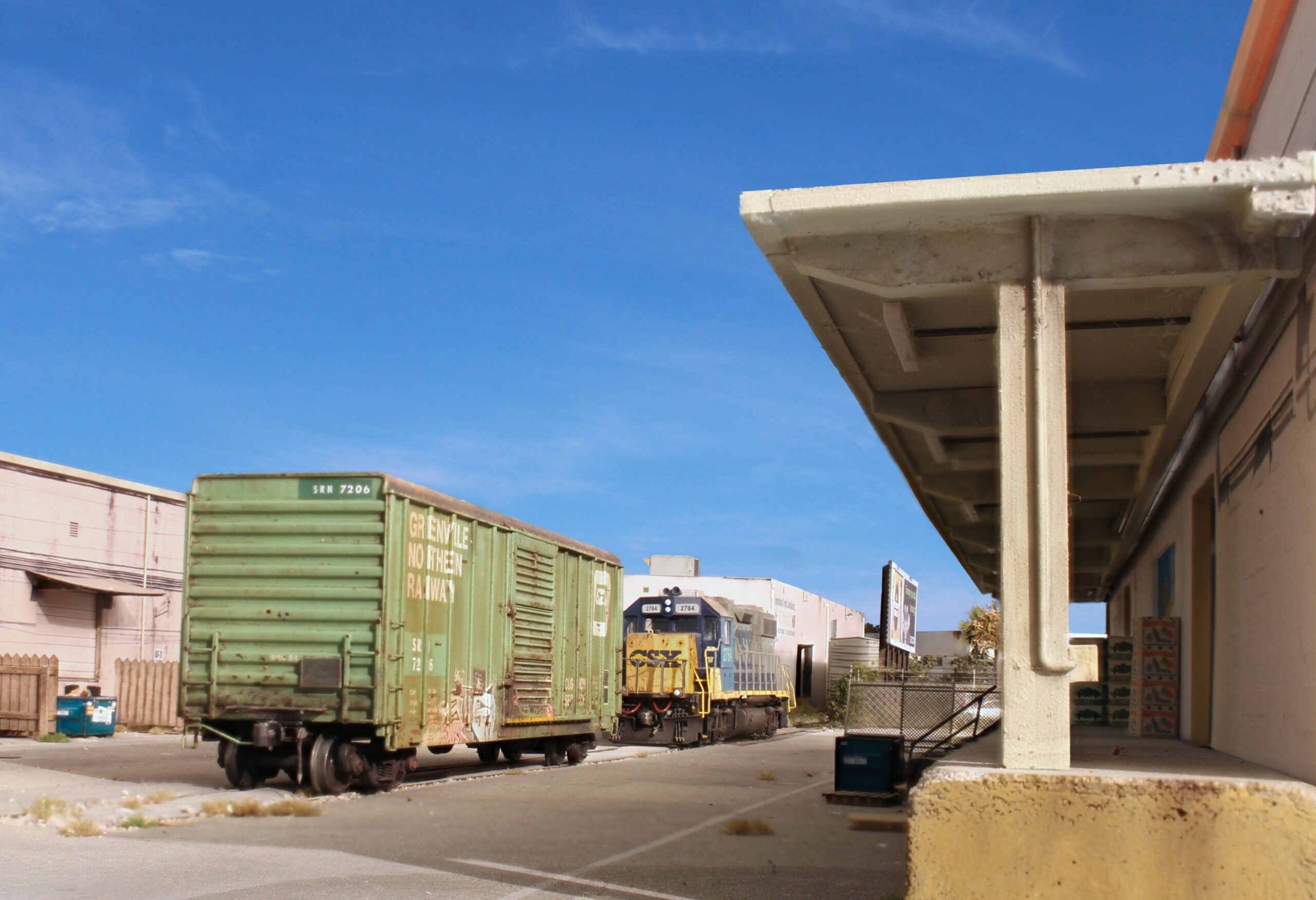
This is how the Lifelike GP-38-2 and Atlas switcher were weathered: Trucks and underbody: Floquil Grimy Black. When dry, I swished on some Weathering Freight Cars
Here's a quick way to easily and subtly weather your freight cars. Not every car needs to be, or should be, a dramatic rust bucket. If you can knock the shine off of the factory paint job and gently tone things down you are well on your way. Grab a box car and try these simple steps. Trucks: Apply a base coat of either Floquil Grimy Black or Floquil Rail Brown. Let it dry a few minutes. Now, apply a light follow up airbrush dusting of Floquil Roof Brown. If you don't own an airbrush, substitute brown weathering chalks in lieu of the Roof Brown. Car Body: Spray the car with Testors Dullocote - WITH AN AIRBRUSH! For whatever reason, bottled Dullcote applied with an airbrush produces much better results than using the Dullcote that comes in a spray can. You'll need to thin the bottled Dullcote before airbrushing. I use a 50/50 mix of bottled Dullcote and Testors Brush Cleaner/Thinner (pn 1156). Next we are going to fog on a very gentle and extremely transparent layer of grime. Take an airbrush bottle and fill it with rubbing alcohol (any strength). Next open a bottle of Polly Scale Steam Power Black, Rail Tie Brown or Both. Tip a paint brush handle into the paint and let a few drops drip into your alcohol. You want the mix to be very dilute. Set your airbrush to 15psi to 20psi and turn the paint volume way down. Test your mix by spraying a white object. The paint should not blast out nor should it be very dark. If it's too dark, re-do your mix. Once you're satisfied that you have the correct mix and airbrush pressure, fog your mix gently over your car. Linger with the airbrush a little longer around the door hinges and lower parts of your model. When you see the slightest trace of color - stop! The key is knowing when to quit. If in doubt, stop and come back an hour later. If things end too light you can always go back later and add more layers. If you go too dark you are stuck. Frequently rubbing alcohol and Dullcote react in such a way as to produce some hazing. If this occurs simply apply another coat of Dullcote and the hazing will disappear. Couplers: These days fewer and fewer operators rely on magnetic uncoupling ramps. If this applies to your situation cut off those unsightly wire "uncoupling hoses" that dangle below your couplers. You don't need them. Vegetation
Grasses, weeds, and underbrush don't get written about much but are things that can dramatically improve the look of your scenery. Working in low lying vegetation around tree trunks can alleviate the dreaded "lollipop" look. For underbrush, take green polyfil, stretch it into airy puff balls, hit it with hairspray and dust on a very faint layer of ground foam. However, avoid using ground foam for grass coverage. Instead, utilize the newer grass mats being produced by Silflor and Heki. Track
The track on this layout is Micro Engineering code 70 flex track. While I did add some details to the rail, the most important aspect of getting it to look realistic is the color treatment. This is how I painted the ties and rail. First, the ties were airbrushed with Model Master "Light Gray" part number FS36492. Let this dry for at least a day. Next, apply a wash of burnt umber artist oils over the ties. I thin the wash to the consistency of weak coffee with mineral spirits. Let the oils dry for several days. Next, mask off the ties leaving the rails and tie plates exposed. Airbrush with Floquil Rail Brown. Follow up with a very light airbrush dusting of Floquil Roof Brown and/or Floquil Rust. It should be noted that each flex track section and turnout was painted individually on my work bench ( a luxury you can afford when your layout is this small). Ballast Some of the major ballast products on the market today are not made from actual stone but are actually crushed walnut shells. The tendency for these products to float as well as their uniform color and texture makes them less than desirable when trying to create a realistic look. Ballast products made from actual crushed stone create a much more realistic appearance and are also easier to work with. One good brand name is Arizona Rock and Mineral Company (www.rrscenery.com) In selecting ballast blends pay special attention to getting an aggregate size that is appropriately sized for your scale. Don't be afraid to use N scale ballast on HO layouts. Structures Tony Koester said it best in his recent scenery book, Planning Scenery For Your Model Railroad. Kalmbach Publishing. "Some model railroads look more like a display of craftsman-style structure kits than a coherent miniature of any actual place and period. Any of the structures could have been a contest winner; seen as parts of a greater whole, however, they failed to do their jobs. ... I view each model as part of a whole. Just a running a local freight is little more than an exercise in switching cars unless its work is considered in the context of the through freights that forward those cars to distant climes, I look at scenery and structures as being complementary to the function of the railroad itself. So my point is that no single aspect of our broad-shouldered hobby should be considered in isolation if we hope to create a plausible model railroad. To that end, we need to examine structure candidates in the same critical light used to make motive-power and rolling stock choices. If you think in terms of an individual structure for your layout, you may choose a building that's a bit over the top, something that would stand out at a theme park. If plausibility and realism are important, however, it may be better to think in terms of groupings of structures. Alone, each building may not amount to much, but together they may constitute a believable town, farm, lumberyard, or whatever."
|