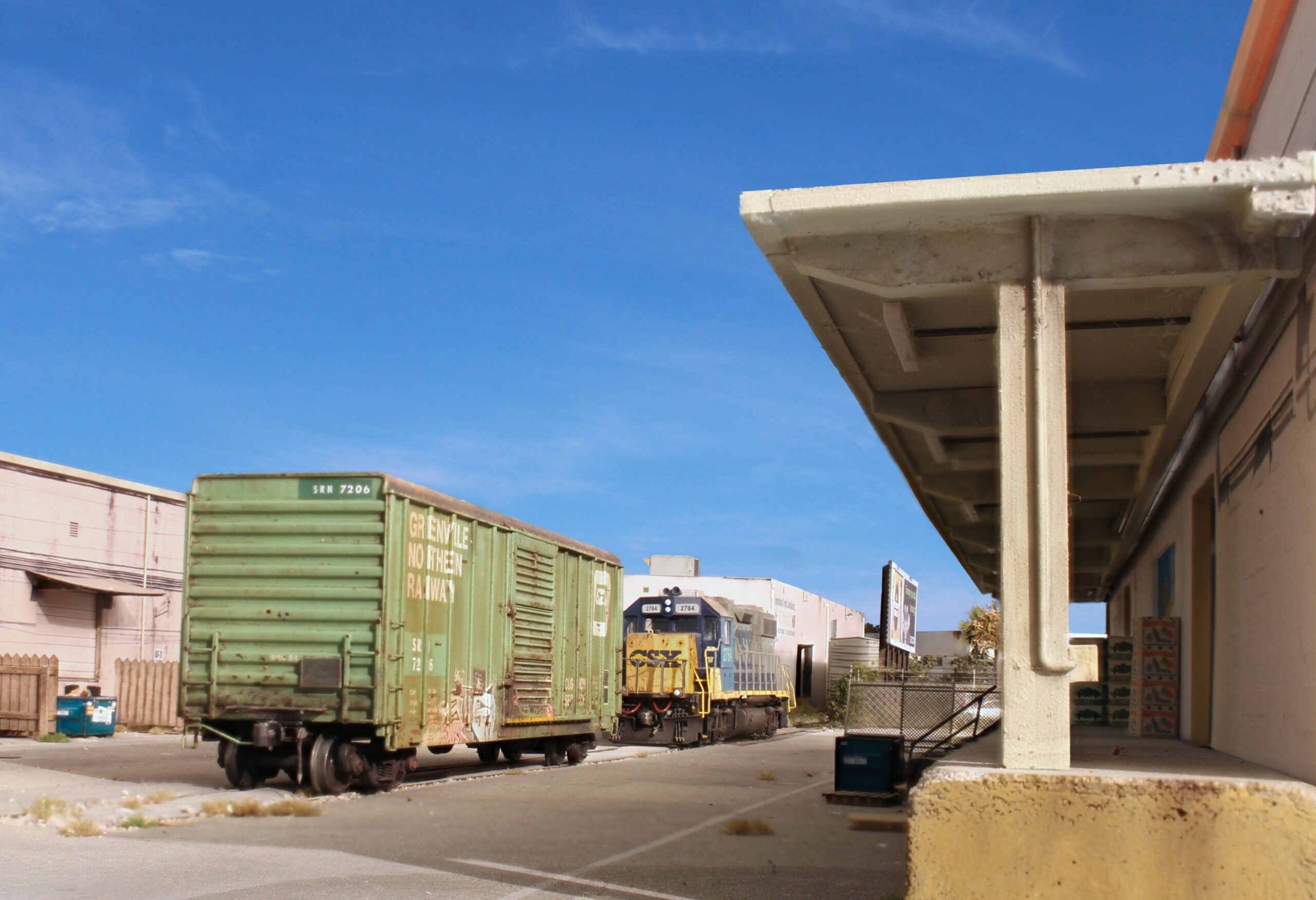
A First Step (4/23/2008)
.JPG)
If you use Atlas, Peco, or Walthers flex track. Paint
it a darker color to downplay the oversize details
My hope for this site is that it be a
resource for fellow modelers interested in improving their overall
modeling results. All of this is nothing more than words in the ether
of the internet if none of the ideas are ever put into practice. Today
lets focus on one easy to implement technique that will result in a
dramatic improvement in the overall appearance of your model railroad.
Specifically, lets address the subject of track and ballast. Railroads
run on track so getting this element looking right will go a long ways
towards making your layout look better. As with most areas of model
railroading, good results are more a result of proper material and color
selection than any magic skill.
For beginners or those with limited time
I suggest the Atlas code 83 product. Its readily available, economical,
and has at least passable appearance. For those looking for the highest
level of flex track detail you'll have to move up to the Micro
Engineering product line. To keep things simple lets start with the
Atlas brand. From a distance the track looks acceptable but the spikes
are fairly oversize. The number one rule of color is to use darks to
downplay imperfections and use lighter color to highlight details.
Since the Atlas track is 'imperfect' its important to paint it a dark
color. Do not paint the rail tan or rust or you will highlight the out
of scale and oversize imperfections in this product. We will use two
colors, both in aerosol spray cans. You will need Floquil Grimy black
and Floquil Roof brown. Again, both in spray cans (available from
Walthers). The order of application is important. Until you get the
hang of it just do short sections of rail at a time. First, spray the
rail with Roof Brown. The order is important so do the brown first. Do
a series of light dusting puffs until the rail and ties are covered.
After that is done, switch cans and give some subtle light puffs from
above and the sides with Floquil Grimy Black. Before the paint dries,
wipe the rail heads clean. The easiest way to do this is to take a
block of 1"x2" pine, wet it in mineral spirits paint thinner and simply
swipe it across the rail head. You're all done. Not too hard was it?

If you use finely detailed, Micro Engineering, track
then paint it a lighter color to highlight the details
Now for the ballast. This is where
material selection is crucial. You have two choices, you can do it the
hard way and get poor results or you can do it the easy way and get good
results. Lets go for the easy way. The key is to use ballast
products made from actual stone. Woodlands Scenics has many excellent
products but their ballast is not one of them! Its tempting to go with
this brand since it is so readily available but it is made from crushed
walnut shells, has a texture that is too uniform and a color that is too
uniform. When you apply your glue mix to this product it will float
everywhere and ultimately stick to the sides of the rail.
Here's a better way. I prefer a supplier
called Arizona Rock and Mineral Company. www.rrscenery.com
The owner, Phil Anderson, will require a minimum order of six bags. For
HO modelers I suggest you order the following: Part No 138-2 CSX blend
HO scale (4bags), 138-1 CSX blend N scale (1 bag), and part no. 1221 N
scale yard mix. The CSX blend is just a generic salt and pepper mix.
The N scale version can be mixed in with the HO scale for variety and is
also handy for general soil use. The N scale yard mix is light cinder
color.
When your ballast order comes in, gently
apply the ballast with a soft brush putting less down than you need and
gradually fill it in with subsequent layers. Take your time, be patient
and make sure no ballast particles are sticking to the rail sides or
ties. Once the loose ballast is in place, take a fine mister bottle of
water and add a splash of rubbing alcohol. Starting from several feet
up lightly moisten the ballast with the mister bottle and then gradually
move the mister closer to the rail. You want the ballast to be wet
through but not puddling with water. Finally, add your fixative. I
prefer a mix of 1 part matte medium, 3 parts water, and a splash of
alcohol. Apply the fixative mix with an eye dropper or old Elmers glue
bottle. Let it dry and you're done!
What if your layout is already complete
with 'orange rail' and walnut shell ballast? Well you are kind of stuck
in that you can't repaint rail once has been ballasted and removing the
offending subject would be a monumental task. My suggestion is to
accept your past results and apply the newer technique to any rail that
has not been laid yet.
Becoming A Better Modeler
(4/14/2008)
I've always been intrigued by the process a person goes
through to develop their skills in any particular endeavor. The actual
activity is irrelevant. It could be athletics, music, art, writing, or
in our case, model building. There will always be those who are born
with great talent. In most cases though it really comes down to desire
and practice. To say that a superior result was obtained simply
because a person was born with a skill diminishes the effort it took for
the person to get to that point.
Building quality models, in my view, breaks down to
45% proper technique and material selection, 45% practice, and at most
10% natural talent. Before we even get that far though there has to be
a desire to be a better modeler.
I need to be clear that there is absolutely nothing
wrong with being happy with your current state of modeling capabilities
and maintaining the status quo. If you're having a good time and
enjoying what you are doing then that is what the hobby is all about.
There can not, and should not, be any apologies for your current level
of modeling ability. Here's an example. I really enjoy fishing. I'm a
terrible fisherman. I never catch anything. Most of the time I don't
want to catch anything. I rarely read fishing magazines. However, put
me on a pier on quiet Sunday morning and I'm quite content. Viewed
that way its quite easy for me to understand how somebody could take a
casual, superficial approach to model railroading and have a great time
doing so.
For me, model railroading is different. This is my
primary hobby and the one I strive to become better at with each passing
month. If a person were to ask me for suggestions on improving their
modeling skills I'd offer up the list below as a starting point.
-As stated above you need to have the DESIRE to become
better.
-Learn from past mistakes. Maybe mistake isn't the
right word. Learn to look back on previous efforts and identify the
areas that need the most improvement.
-Ask for advice
-As important, implement the advice you were given
-Develop an eye for what looks good and what does not.
-Stay abreast of the more modern techniques and
materials (Static grass, etc.). Many people cling to old materials and
techniques long after more effective methods or better looking materials
become available.
-Master the basics of creating clean joints and seams on
your models. Make sure things that should be straight are straight,
corners are at 90 degree angles and that there are no unsightly gaps at
your joints. This is easier said than done and comes with time and
practice.
-Study the work of those you strive to emulate and
evaluate what is different about what they've done.
-No matter who you are, you will always be improving.
Your past efforts won't be as good as what you can do now. Accept this
and enjoy where you are on the modeling skill spectrum. Look back on
previous efforts without regret and acknowledge they were your best
effort at that point in time.
-Practice. When trying a new technique practice on a
sample, off the layout, until you can produce acceptable results.
-Study high quality 'how to' DVD's
-Practice basic neatness at all levels
-Pay particular attention to color and flat sheen
-Avoid the temptation to add too many elements to your
model railroad scenes. Scene composition is very important.
-Learn how to use india ink/alcohol weathering washes.
-Learn how to use black and brown weathering chalks.
-Learn to scratch build structures. Scratch building a
structure is often easier than wrestling with a poorly manufactured kit.
-Build models on a consistent basis. Don't go for
extended periods of time without doing anything.
-Attend prototype modeling seminars
-Carefully study prototype photos and copy what you see
in miniature
You can do it.... if you want to.
Tools (4/7/2008)
I recently attended seminars put on by master modelers
Mont Switzer and Bill Darnaby on the subject of model railroading
tools. As I sat down for the seminars, I prepared to be wowed by an
extensive list of expensive, ultra-sophisticated tools that would
literally make my models fall together perfectly. At the end of the
seminars I was quite under whelmed. My bubble had been burst. There
were no 'super tools'. They don't really exist. I laugh when I look
back on it and they laugh when I recount to them how they let the air
out of my balloon. The truth is, when it comes to model railroading
tools you really do not need much. From a cost standpoint this is good
news in that it means exceptional results are available to all
regardless of financial resources. Here are some basics.
-Number 11 blades. Sharp ones and lots of them. Change
your blades often. Single edge razor blades work equally well
-A few small screw drivers
-Hand held pin vise (aka twist drill) and small drill
bits
-Tweezers
-Sandpaper in a variety of grits from 100 to 600.
Sanding sticks are handy but not necessary.
-Three or four files of varying shapes
-Pins (Straight, T, or Push) to apply glue
-Super glue (regular and gel)
-Testors liquid plastic cement
-A steel straight edge. Better yet, a steel scale rule
will kill two birds with one stone.
-Optivisor magnifying glasses
-Bragdon Weathering Chalks
http://www.bragdonent.com/about.htm (Black and Chocolate Brown only)
Part numbers FF-64 Soot Black, FF-69 Brown
-India Ink/Alcohol weathering wash. Make two strengths
(1 tsp Higgins ink per pint of 91% alcohol and a stronger batch made
with 2 tsp per pint)
-Aerosol spray paint: Ultra Flat Black, Charcoal Primer,
Light Gray Primer, Grimy Black, Roof Brown, Rustoleum Textured Paint
(sandstone color)
-TRASH CAN. Get in the habit of discarding sub-par
efforts quickly. If a project doesn't turn out, pitch it and start
anew.
Optional (Handy but not essential)
-An airbrush and compressor are nice but you can live a
long time without one.
-Steel angles
-Northwest Shortline Chopper
-Dremel tool

This is where it all happens. Sorry to disappoint but
this is really all it takes to put a model together. Note my
sophisticated organizational system: long straight things on the right,
glues on the left, chalk in the back.