2009 Archives
Home ] Up ]


2008 Archives
2009 Archives


2009


December 19, 2009:  Over the past few weeks I worked in the pavement and scenery details around Genaro Produce and Miami, Inc.  I also built the structure for Miguel Alvarez Co., a small pallet business tucked in next to Genaro.  I may put off the permanent Micro Engineering track in this stretch for awhile so for now I just painted the temporary Atlas track that is currently in place and left it un-ballasted.


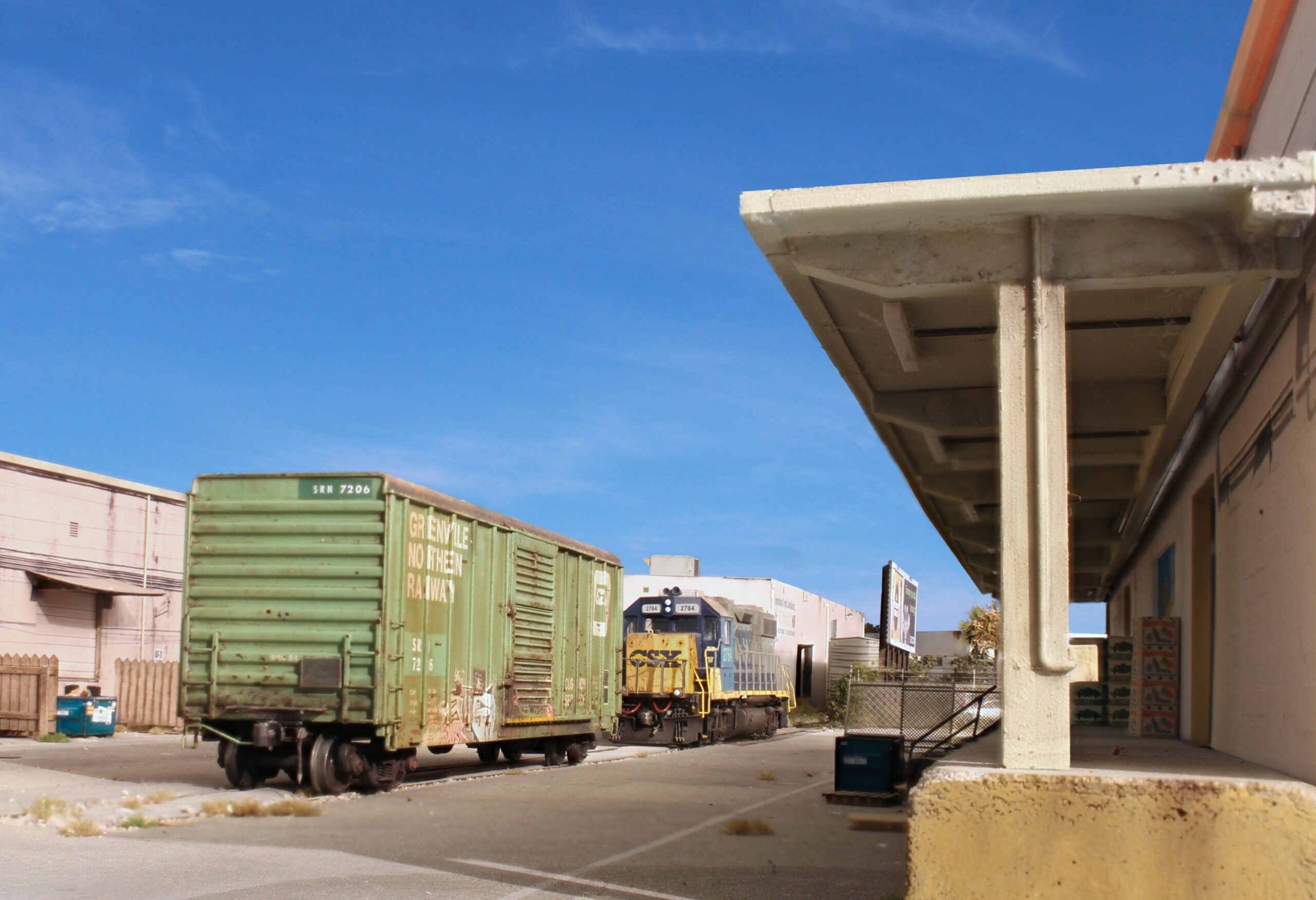
November 29, 2009:  I took advantage of the long Thanksgiving holiday to wrap up the last two key structures along 22nd street, Genaro Produce and Miami, Inc.  Genaro takes rail shipments, Miami, Inc. does not.  Genaro is an interesting case in that it doesn't have it's own spur.  Rather, the runaround track siding is across the street from it.  Cars are left on the siding and the contents trucked the 100 feet or so across the parking lot.  Since these structures are located directly under the bathroom in our house (which malfunctions once a year) I opted for traditional styrene construction methods.  In both cases I used a 'reasonable representation' approach asopposed to making an exact replica.


Left to right: Pizzeria, gray storage warehouse, stucco residence, Florida Used Pallets office (pink), Florida Used Pallets warehouse(gray).


Left photo: The prototype facing south/southwest on 22nd Street.  Seventh Ave. is to my back.  Right photo: Location of the scene on the layout.

November 22, 2009:  One of my favorite scenes is  the short block of 22nd Street between 7th and 8th Avenues.  On the south side of 22nd you have a Pizzeria, , a small warehouse, a stucco residence, and Florida Used Pallets.  Paralleling 22nd street just a few feet north of the road's shoulder is the tail of the switchback.  I used a both conventional methods and photo wallpaper to build the structures.


November 8, 2009: Finished the two structure complex for Florida Used Pallets (formerly Metro Used Pallets) at 22nd Street and 8th Avenue.  One of the keys to realism is to model the ordinary.  Each and every structure on the layout need not, and should not, be a contest winning attention getter.  You are looking for the overall effect of combining groups of structures.  You model what is there regardless of whether or not they are architectural masterpieces.  The Florida Used Pallets buildings were somewhat on the understated side.  Nonetheless I found  building them to be an enjoyable weekend project and am happy to have them.  Special thanks to Tom Klimoski for the photos of the west (gray) structure.


November 2, 2009: Finished detailing and weathering my Atlas GE B30-7. Weathering was as follows:

bullet

Fogged on a very dilute wash of Polly Scale (acrylic) light gray over the entire body.  You need to keep the gray very dilute and light to add just a hint of fading.  In a few places the airbrush left tiny gray 'spit marks' that were visible on the blue.  I gently smeared these in using a q-tip moistened with Windex using a downward motion.

bullet

Added shadows to the panels using the black wash/q-tip method outlined  in the Narita tutorial  here (see day 21).  I used Model Master flat black enamel (thinned 10:1) and Model Master enamel thinner as per the instructions in Mr. Narita's tutorial.  This method was very simple and very effective. 

bullet

Dry brushed Polly Scale Catwhisker Yellow over the yellow areas to lighten them up.

bullet

Added rust spots using burnt umber artist oils and mineral spirits

bullet

Sealed with Dullcote.

bullet

Added a bit more weathering with black chalk around the stack and brown chalk on the sills

bullet

Painted the roof white and weathered slightly with a wash of black artist oils

bullet

Painted trucks Grimy Black.  Fogged on Rail Brown on the tank and Grime on the trucks.  Added streaks with black and brown chalks


October 25, 2009:  Progress has been made but nothing photogenic.  I finished up installing the last overhead light fixtures and ceiling tiles as well as the last window blind.  I also finished feathering in the scenery around the base of the recently completed del Toro structure.


October 13, 2009:  The first time I saw the del Toro signs facility I didn't care for it that much.  Over time it gradually grew on me to the point where I had to have it.  The burgundy and gold paint scheme with the faded blue bull really is eye catching.  The structure itself ended up being much simpler to build than I expected.  It's basically a box with a large freight door on one end.  I selectively compressed it to two thirds it's actual size and used photo wall paper for the base panels.  There is simply no way a paint scheme this complicated could be done any other way.  I cropped out as much of the fence as I could and then cropped in new doors.  The scuppers, downspouts, and electrical hardware are all stand off details.  Having learned my lesson from the D&E Argentinas structure, I opted for smaller downspout pipes and like that look better.  The freight door is a photo I took last weekend.  I took some graffiti from another photo and cropped that onto the freight door.  The roof is a photo I took down the street.  The awnings are .005" styrene which has been cut and folded to shape.  A year into this layout my construction pace has really picked up.  I no longer feel like I have to re-invent the wheel with every step.


October 8, 2009:  Here's the completed structure for D&E Argentinas.  Unlike previous structures on the layout, I used primarily traditional techniques here.  The walls are painted styrene, the door frames Rix, stairs and railing are Walthers, A/C unit is BLMA.  The personnel and roll up doors are photographs inset into Rix frames. The conduit is painted spring wire.  This structure is directly below the bathroom upstairs (which seems to overflow every 18 months).  That being the case, I felt I needed something a bit more 'waterproof' than photo wallpaper.  Many thanks to Tom Klimoski for taking the prototype photos that made building this structure possible.


October 4, 2009:  Progress from the weekend.  Completed at this point are: the core, custom door frames, a/c notches in wall, roof base and trim, base coat.  There is still a lot of detail and weathering to work on but the hard part is done.


October 2, 2009: Started working on D&E Argentinas (not rail served), located on 10th Avenue across from 10th Ave. Tires.


September 25, 2009:  I've been working at a leisurely pace lately.  Since the last update I added the scenery base around the rail right of way at the end of the switchback.  Even in an area as lush as Miami the grass is often a dead brown around the tracks.  Comparing the model to the prototype photos there is way too little trash and debris on the model.  I'll have to go back and work on that some more.  My friend Vianney dropped in from France and donated the very nice Athearn 53' reefer trailer to the cause.  A very, very light black wash follow by Dullcote toned it down and brought out the finer details.


Model, prototype, and dimensional photo of 'backsaver' style of switch throw.

September 7, 2009:  I've been waiting for some nice photo etched backsaver style switch throws to come on the market.  Nothing so far although Proto:87 stores is considering adding them to their line.  At this point I had no choice but to fashion my own.  On my trip to Miami in 2008 I did measure one and have attached the sketch here.  The model was fashioned out of some very small brass stock in my scrap box.  This is one of those things that will look horrid if you get any kinks  in the wire while your are forming it.  It took me a few tries but I finally got one the correct shape.


August 29, 2009.  I've started working on the end of the spur at 7th Avenue and 22nd Streets.  This is an interesting area and really has an 'end of the line' feel to it.  In the prototype photo the Downtown Spur ends under the blue car.  Scene composition is one of the more difficult aspects of modeling to master and can be hard to define.  Essentially it's how you size and arrange the various elements.  I find this virtually impossible to plan for in a two dimensional drawing.  As an aid I glued some photos to styrene sheet and arranged the structures until I had the right look.  There are eight mock ups in this scene and it took one afternoon to whip them up.  The pavement for 22nd street is complete though.


August 8, 2009:  This is a milestone date to an extent in that I have now finished the switchback peninsula. The past several weeks have been spent mounting the pavement areas, seating the structures into their foundations, and finishing scenery, signs and details.  My goal was to have the peninsula done by the end of the year.  After a slow start, I gradually got my sea legs under me, started getting more efficient at urban modeling, and was able to get done ahead of schedule.   I have noticed that whenever I change scales, era's, or scenery types the first six to nine months are slow going as I make the adjustment.  I guess they call that a learning curve.


Here's the finished intersection in place.  Notice how effective the india ink wash is as far as toning the colors down.

July 28, 2009:  The above photos are of the pavement at the 10th Avenue/21st Terrace intersection.  For larger pavement areas such as this I do a lot of the initial work at the work bench before I install it on the layout.   I use .060" styrene as a starting point. Sidewalks are from Walthers.  Two shades of gray are used, light gray primer for the pavement and Model Master light gray for the sidewalks.


July 17, 2009: Here's the completed structure - simple but sort of interesting.  I especially like the gray/dirty pink color combination. I used the standard photo wall paper format for the walls.  3D elements are: recessed doors, scuppers, burglar bars, electrical boxes and conduit, and the awning over the door.   Since this is not a critical structure in the grand scheme of things I didn't want to spend an inordinate amount of time on it.


July 14, 2009: Started construction of the 10th Avenue intersection.  The prototype photo is facing west.  I'm building the entire intersection area on my work bench.  The structure is the old 10th Avenue Tires building.


July 7, 2009:  Finished the Proveedora Jiron structure.  Click the thumbnail above for detailed photos. A special thanks to Tom Klimoski for providing the research  photos necessary to build this model.


July 2, 2009:  Started construction on the Proveedora Jiron structure.  Shortly after the photo on the left was taken in 2007, the structure was repainted a dark mustard color with boxcar red trim (right photo).  I'll be modeling the more recent paint scheme.  The top photo shows some of my tools, the most recent of which is the brick, available from Walthers under the product name 'Nit-Picker-B-Gon".

June 28, 2009: Completed structure for F&R Scaffolds.


June 20, 2009: Roof canopies added to F&R


June 13, 2009:  I started by building up the walls first.  The base is acrylic, the walls are .060" styrene with photos laminated on.

June 13, 2009: Tucked into the west of Proveedora Jiron is an interesting structure housing a scaffolding dealer.  Note the ghost image bleeding through the paint on Tom Klimoski's prototype photo.


May 29, 2009:  The structure for Florida Bottling is now complete.  This structure is not very glamorous.  I considered jazzing it up a little but decided to stick to the prototype.....mostly because I'm lazy and that was easier.  The most challenging part of the job was the battered and dented galvanized downspouts around the loading door.  For these I used K&S square tube which I weathered with Dullcote, an India ink wash, and chalk.  The scuppers had to be custom made.  I  carved one out of styrene, made some simple clay molds, and cast the rest.  The electrical conduit bank on the west face was a little tricky.  For that I used K&S tube.  The loading dock configuration seems to change yearly.  I modeled the version from a few years back as per what is seen in Tom Klimoski's photo.  The dock has since been doubled in size and cleaned up.

May 15, 2009: I finally completed construction of the A-1/Farmers Choice structure.   Have you ever had one of those modeling projects where nothing seems to go right?  This was one for me.  For starters, my large format printer which I use for the wallpaper, croaked mid-project.  Those things aren't cheap either.  After that it was one little thing after another.  At any rate it all worked out in the end but I had to work for this one.


April 25, 2009: Started fabricating the permanent A-1/Farmers Choice structure.

April 22, 2009.   The vehicles and dumpsters for the Waste Management storage lot were completed.  The Trucks are from Boley, the dumpsters from Walthers.  Custom made decals were applied to both.


April 8, 2009.  The model of Kiko's wholesale was finished.  Click the thumbnail above for photos of the finished model.


April 5, 2009:    This week I finished the Waste Management truck storage lot off of 11th Avenue (left photo).  I think I'm now on track for the least glamorous model railroad ever built!   In the right photo I've added a few more weeds and trash to the passageway behind A-1 to more closely match the ragged nature of what is actually there.


March 29, 2009.  Here's the progress to date on the ratty Waste Management parking lot across from A-1 Produce.  While on the pricey side, I've been very happy with the BLMA chain link fence.  The mesh is very fine.  The key to taking advantage of that fineness is to NOT paint it.  Instead, I airbrushed it with Dullcote and then hit it with a dilute alcohol/india ink mix.  For the posts I super glued some thin wire to the face of the etchings.  The barbed wire is Berkshire Junction EZ Line (another great product) purchased from Caboose Hobbies.

For a change of pace I decided to do some rolling stock work.  Many thanks to Cody Grivno at Model Railroader for digging up the prototype photo for me.  The car is a standard Athearn RTR car.  As a starting point it was decent although the ladders were much more oversize than some of their other RTR cars.  Added details were: scale couplers, coupler cut bars, end platforms, air hose, Kadee brake wheel, and new stirrups. If I were to do it over again I would have replaced the ladders.  Weathering was as follows: 1) Trucks and underbody, grimy black with roof brown dusting right from spray can.  2) next up was artist oils on the roof and sides. 3) a dilute grimy black/roof brown mix was airbrushed over everything  3) to lighten the blue up a very dilute mix of Dullcote, dust, and white was puffed on the sides.  4) the car was finished off with some brown and black chalk at the bottom and door hardware.


Above are photos showing progress on the peninsula as of March 15, 2009.


The first scene completed on the layout was the 12th Avenue Courtyard.  Click the thumbnails above to view more details of: the overall courtyard scene, the Miami Produce