|
|
|
|
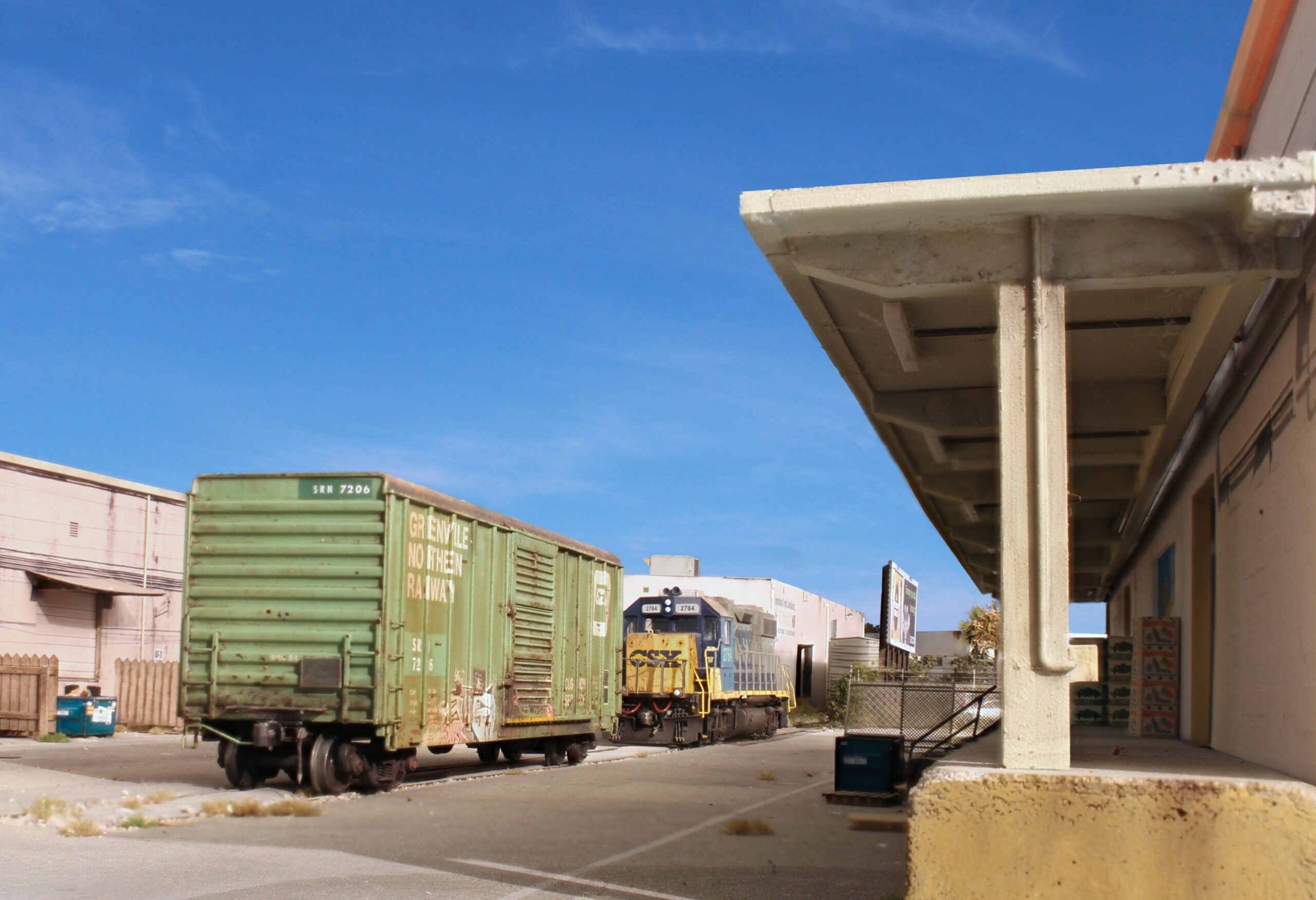
Here are some progress photos as of November 30, 2008 showing the photo mock ups on the switchback peninsula.
Roadways are structures too, and often just as challenging to model as buildings. One of my first projects is to get started on some of the streets. Here's an overhead view of the model of 17th Avenue. I considered a lot of materials before setting on traditional styrene for this model. There were so many parts and so much masking I needed the extra control styrene allows and the ability to work with the pieces on my work bench. The street is painted with Rustoleum gray primer. The sidewalks are Model Master light gray. Most of the markings are a mask and paint job which takes quite awhile. The crossing emblem is a dry transfer from Greg Komar. Once the basic painting was completed I airbrushed on a very dilute india ink/alcohol wash. The exhaust stains in the middle were made with a very dilute mix of grimy black and roof brown. --------------------------------------------------
This photo shows the progress as of October 10th on the Miami River peninsula area. I'm not a big fan of peninsula's like this but often they are a necessary evil. Such peninsula's are not very realistic and they eat up an enormous amount of space. Having said that it, was the only way to get the CSX main (which doubles as staging) into the mix. Looking at the plus/minus ledger the benefits of the peninsula out weigh the negatives. The Atlas code 83 track is only temporary and was used to get me up and going quickly. It will gradually be replaced with Micro Engineering code 70 flex track. I've always been impressed with the Atlas product though. Its economical, reliable, easy to find and doesn't look half bad.
Here's a close up showing the switchback leading into the Miami Produce Center.
This view shows: the addition of the fascia, Thermo-King ceiling tiles, additional mock-ups, and the permanent mounting of my control system. On my Monon layout I learned the downside of traditional ceiling tiles - a never ending dusting of tile dandruff which was a real nuisance. On this layout I'm trying out 'clean tiles' from ThermoKing. While more expensive, the ThermoKing tiles are made of plastic and do not flake over time and are waterproof. We'll see how they work out. The floor is still subject to a fair amount of construction dirt so there is no sense putting a nice surface down only to have it ruined a month later. The fascia is standard floor baseboard trim.
The photo mock-ups of the block between 13th and 14th Avenues are now complete. The photo on the left (Microsoft Live.Local aerial) is facing west. The model photo on the right is facing west/nw.
Here's the same scene looking northeast with 22nd Street in the foreground.
In an effort to produce a cleaner, more comfortable look the electronic components have been mounted on a floating shelf ($20. Home Depot). The command station and programming track are placed in an under counter sliding drawer (Home Depot). I've found that having the command station mounted flat makes viewing much more comfortable.
Urban layouts are unique in that they require many more labor hours per square foot than more rural themes. It makes sense to do a trial run on your scene composition with simple mock ups before investing a lot of time building structures. It was this type of trial run that lead to the decision to do the mirror image flip of my track plan. With the initial trial run done and much of the plan finalized, my plan is to quickly but neatly lay all of the track with Atlas code 83 laid loosely in place and held with a few drops of white glue. Structures will initially be photo mock-ups. Next I'll hook up the dcc system and start running trains. Once I have all of that sorted out I'll go back and replace the track with Micro Engineering code 70, replace the mock-ups with actual models and begin the scenery. Scene composition is something that is hard to learn by reading books or articles. This is unfortunate in that it is one of the more important elements in creating a realistic model of a railroad. Our problem is compounded by the fact that as the model track progresses around the room we are constantly faced with the maddening need to make 90 degree or 180 turns, must duck room columns and utilities, and never seem to have enough room to do what we want to do. The challenge is to compress our scenes so that they fit, appear un-crowded, and also arrange all of the elements so that they bear a reasonable facsimile of the real thing.
The scene above features the block between 21st and 22nd Avenues. The primary structures are: The Produce Connection, Family and Son, and Northwestern Meat. Photos of the prototype were manipulated with a photo editor and glued to styrene blocks. Looking at the model you are facing roughly north/nw. In the prototype photo you are facing west/nw.
This scene encompasses the block between 11th and 12th Avenues and features the semi-vacant Gulf Atlantic warehouse on the left and the larger shipper Trujillo Foods on the right. In both views you are looking west.
Here are some close ups of the bench work. The bench work of the sections following the walls is made of 18" hollow core doors. The doors are spliced together by a 1"x4" board. Decorative shelf brackets without knee braces support most of the shelves. On the longer shelf runs I put a knee brace style bracket in the middle of the run for added strength. At the point the shelves meet the walls, the shelf ends are supported by 1"x2" beams screwed to the studs. The peninsula's are simply traditional box girders slabs. The photo on the right shows how the two bench work styles are joined. |